Order communication
improvement
A six-week project focused on clearer order communication, confirmation and payment-related processes across Pindo’s marketplace.
Overview
Pindo is an online marketplace where users can buy and sell new products and services directly.
The order management system connects buyers, sellers, customer support, payment operations and backend services. As the number of order scenarios increased, the existing system became difficult to follow and manage.
This project focused on improving order communication, order confirmation and payment-related processes.
Make every stage of the order process clear.
Users were sometimes informed too early, too late or not at all. Some order stages were missing from the communication flow, while edge cases were left without a clear next action.
Six issues shaped the opportunity.
Turn disconnected messages into a structured service flow.
For each order stage, the team defined what had happened, who was responsible for the next action, what information they needed, which message should be sent and what should happen if they did not respond.

Mapping the existing service.
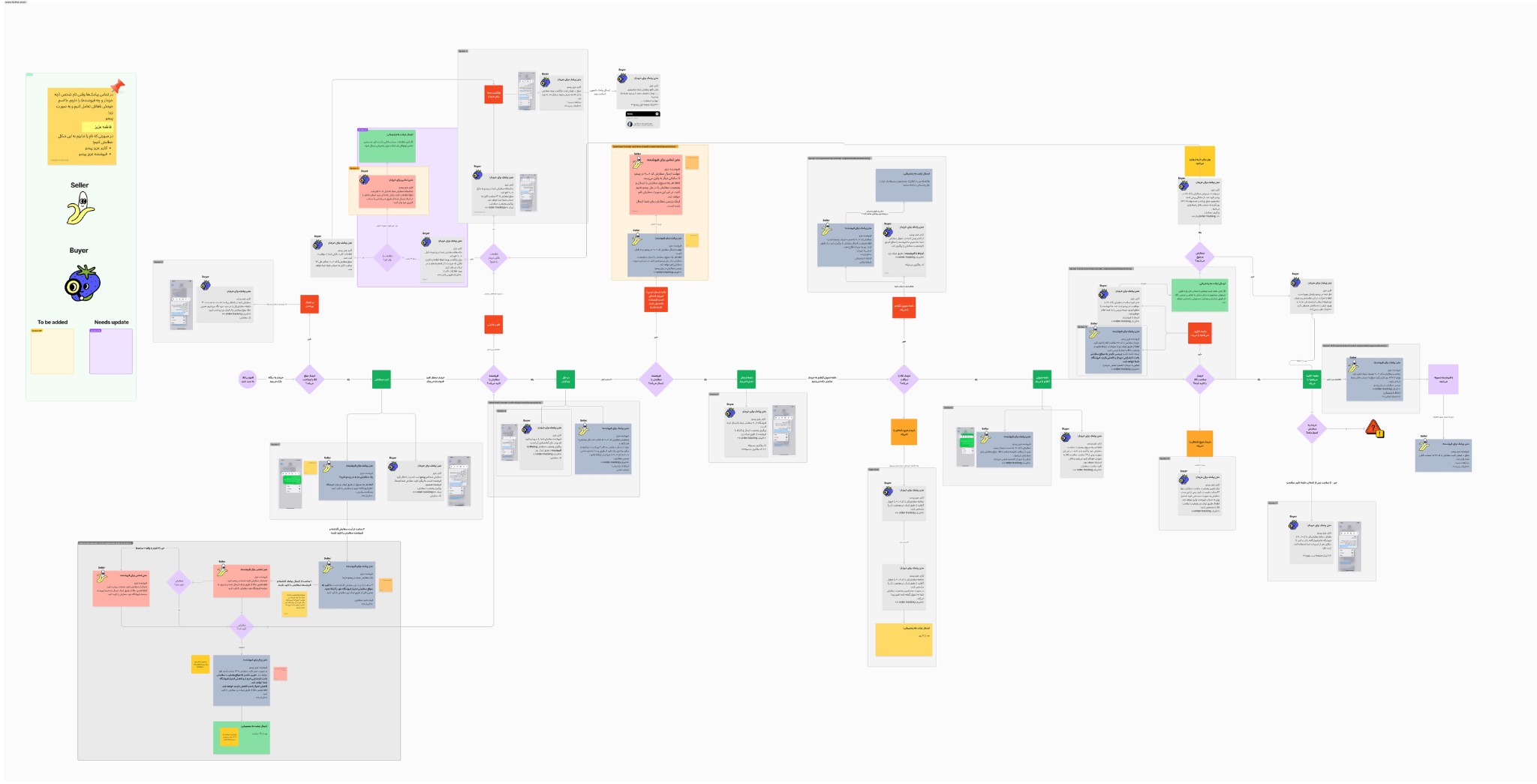
I created a detailed flow diagram connecting buyers, sellers, system states, messages and internal actions.
The map included existing order states, confirmation and delivery scenarios, SMS and in-product communication, payment and settlement conditions, support interventions and unresponsive-user scenarios.
Two characters, one very busy order journey.
Meet Seller and Buyer. They are the two main characters in this flow, constantly passing updates, waiting for responses and trying to understand what happens next.
Every message in the system exists to help one of them move the order forward.
 SellerBuyer
 Hover to zoom · Click to open full size
Designing communication around the actual order state.
I reorganised the messages so they supported the current stage of the order and made the next step understandable without support assistance.
Start with confirmation and settlement.
The first phase focused on two critical areas: giving buyers a clear confirmation SMS and establishing a more structured framework for automatic payment and settlement processes.
For each condition, I documented the trigger, responsible user or system, expected action, message, fallback scenario, internal follow-up and measurement metric.
Translate the service logic into implementation work.
As the Product Manager, I worked with the data team and backend developers to prioritise the most critical blockers first.
I translated the flow into detailed Jira tasks with the required conditions, system behaviour, message content and edge cases. I also coordinated reviews with buyer-side, seller-side, backend and data stakeholders throughout the six-week project.
Tracking the full communication service.
To evaluate the effect of the changes, I defined a measurement set covering buyer and seller behaviour, message performance, operational effort and support demand.
Continue measuring the wider service.
The first phase measured its impact primarily through order-related support tickets. A more complete evaluation would also include confirmation completion, unresolved orders, time to settlement, delivery confirmation, manual interventions and user satisfaction.
Fewer questions about order status.
Before the release, order-related support tickets averaged approximately 2,400 per month. After implementing the new confirmation flow and related system conditions, these tickets decreased by approximately 30%.
The remaining phases were planned to address additional order-management scenarios across the wider service.
Service quality depends on the full relationship between states, messages and operations.
This project showed that improving order communication requires more than rewriting individual messages. Mapping the complete flow made it easier to see where the service problem actually occurred and to prioritise the highest-impact blockers.